
If you run a small business, you already know that showing up on Google isn’t optional anymore — it’s survival. Yet most small business owners either skip SEO entirely or get lost in a sea of confusing jargon.
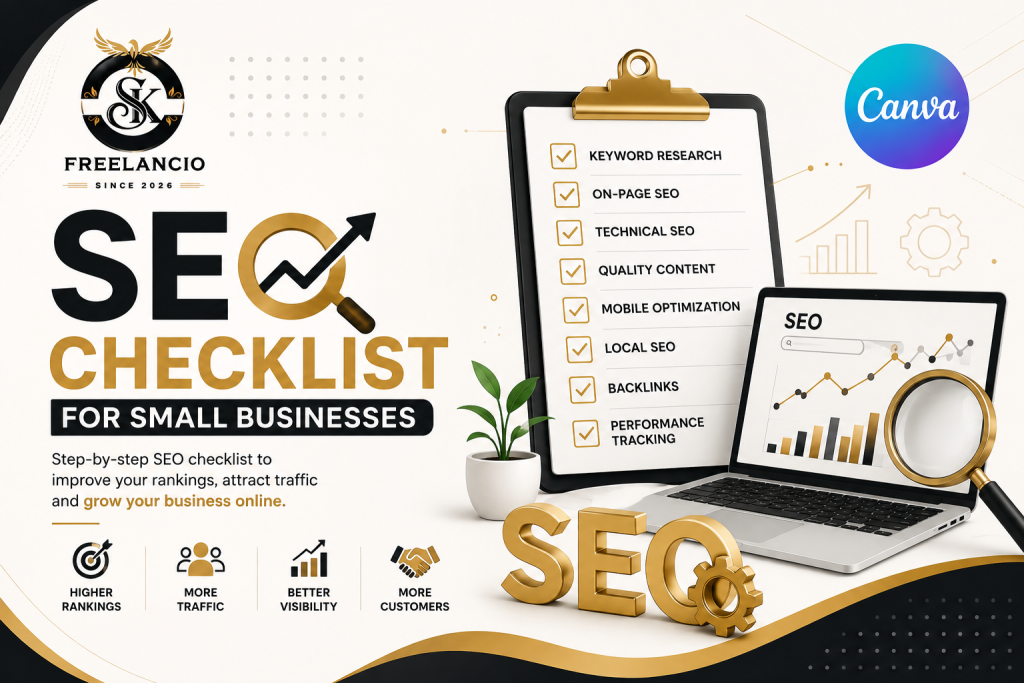
That’s why we put together this complete SEO checklist for small businesses — a practical, no-fluff guide you can actually follow, whether you’re a local bakery, a plumbing service, or an online store just getting started.
At SKFreelancio, we help small businesses grow through smart, affordable digital marketing — and SEO is always where it starts. Let’s break it down.
Why Small Business SEO Matters
Before jumping into the checklist, here’s the reality:
- 93% of online experiences begin with a search engine.
- 46% of all Google searches are looking for local information.
- Businesses that appear on page 1 get over 90% of all clicks.
If your business isn’t optimized for search, you’re invisible to the customers actively looking for you. That’s where a solid small business SEO strategy changes everything.
✅ The Complete SEO Checklist for Small Businesses
1. Claim and Optimize Your Google Business Profile
Your Google Business Profile (GBP) is the single most important local SEO tool you have.
- Verify your business on Google
- Add accurate business name, address, and phone number (NAP)
- Choose the right business categories
- Upload high-quality photos
- Collect and respond to customer reviews
- Post regular updates and offers
📌 Businesses with complete GBP profiles get 7x more clicks than incomplete ones.
2. Do Proper Keyword Research
Don’t guess what your customers are searching — find out.
- Use tools like Google Keyword Planner, Ubersuggest, or SEMrush
- Focus on local keywords (e.g., “digital marketing agency near me”)
- Target long-tail keywords with buying intent (e.g., “affordable SEO services for small business”)
- Analyze what keywords your competitors are ranking for
This step forms the foundation of your entire SEO strategy for small businesses.
3. Optimize On-Page SEO
Your website pages need to speak Google’s language.
- Write unique, keyword-optimized title tags (under 60 characters)
- Craft compelling meta descriptions (under 155 characters)
- Use H1, H2, H3 headings properly with target keywords
- Add keywords naturally in the first 100 words
- Optimize image alt text
- Use clean, descriptive URLs (e.g.,
/seo-checklist-small-business)
4. Improve Website Speed and Mobile-Friendliness
Google prioritizes fast, mobile-friendly sites — and so do your customers.
- Run your site through Google PageSpeed Insights
- Compress images before uploading
- Enable browser caching
- Use a mobile-responsive design
- Remove unnecessary plugins or scripts
⚡ A 1-second delay in page load can reduce conversions by up to 7%.
5. Create High-Quality, Helpful Content
Content is still the backbone of every successful SEO checklist for small businesses.
- Publish blog posts that answer real customer questions
- Target one primary keyword per page/post
- Add internal links to other relevant pages
- Update old content regularly to keep it fresh
- Include clear calls-to-action (CTAs)
6. Build Local Citations and Backlinks
Search engines trust businesses that other trusted sites mention.
- List your business on directories like Yelp, Justdial, Bing Places
- Ensure NAP consistency across all listings
- Get backlinks from local blogs, news sites, or industry partners
- Guest post on relevant websites in your niche
7. Optimize for Local SEO
If you serve a specific area, local SEO is non-negotiable.
- Create location-specific landing pages
- Add local schema markup
- Embed a Google Map on your contact page
- Use city/region names naturally in content
- Encourage local customer reviews
8. Track, Measure, and Improve
SEO isn’t “set it and forget it.”
- Set up Google Analytics and Google Search Console
- Track keyword rankings monthly
- Monitor organic traffic trends
- Fix crawl errors and broken links
- A/B test titles, meta descriptions, and CTAs
Quick-Glance SEO Checklist Summary
| Task | Priority |
|---|---|
| Google Business Profile setup | High |
| Keyword research | High |
| On-page optimization | High |
| Mobile & speed optimization | High |
| Quality content creation | Medium |
| Local citations & backlinks | Medium |
| Local SEO pages | Medium |
| Analytics & tracking | Ongoing |
Final Thoughts
SEO doesn’t have to be overwhelming. By following this SEO checklist for small businesses, you’re already ahead of most competitors who either ignore SEO or do it inconsistently.
Start small, stay consistent, and track your progress. Over time, these steps compound into steady, predictable organic traffic — the kind that keeps bringing customers without paying for every single click.
Need help implementing this checklist? At SKFreelancio, we specialize in helping small businesses rank higher, get found locally, and grow online — without the confusing jargon. Get in touch with our team to see how we can boost your search rankings.
Frequently Asked Questions (FAQ)
1. How long does SEO take to show results for a small business? Typically, small businesses start seeing noticeable improvements in 3–6 months, with stronger results building over 6–12 months of consistent effort.
2. Is SEO worth it for small businesses on a tight budget? Yes. Unlike paid ads, SEO delivers long-term, compounding results. Even basic optimization (Google Business Profile + on-page SEO) can significantly boost visibility at low cost.
3. What’s the difference between local SEO and regular SEO? Local SEO focuses on ranking for location-based searches (like “digital marketing agency near me”), while general SEO targets broader, non-location-specific keywords.
4. Do I need a blog for SEO to work? While not mandatory, a blog helps you target more keywords, answer customer questions, and build topical authority — making it one of the most effective SEO tools available.
5. Can I do SEO myself, or should I hire an agency? Basic SEO steps (like GBP optimization) can be done yourself. However, for competitive niches or faster results, working with an experienced agency like SKFreelancio saves time and avoids costly mistakes.
6. How often should I update my SEO strategy? SEO should be reviewed monthly and updated quarterly, since search engine algorithms and competitor strategies constantly change.
Want a custom SEO audit for your business? Contact SKFreelancio today and let’s build a strategy that actually gets results.