
You’ve built a website. It looks clean, loads fast, and gets a decent amount of traffic every month. But there’s one problem: it isn’t generating leads. Visitors come, browse a bit, and leave — without filling out a form, booking a call, or making a purchase.
If this sounds familiar, you’re not alone. Thousands of businesses struggle with low website conversion rates every single day. The good news is that lead generation problems are almost always fixable once you know where to look.
In this article, we’ll break down the seven most common reasons your website isn’t generating leads, and exactly what you can do to turn things around.
1. Your Website Lacks a Clear Call-to-Action (CTA)
One of the biggest reasons websites fail at lead generation is the absence of a strong, visible call-to-action. If visitors don’t know what to do next — whether that’s “Request a Quote,” “Book a Demo,” or “Download the Guide” — they simply won’t do anything at all.
How to fix it:
-
- Place a clear CTA above the fold on every key page
-
- Use action-oriented language (“Get Started,” “Claim Your Free Trial”)
-
- Make your CTA buttons visually distinct with contrasting colors
-
- Avoid vague phrases like “Submit” or “Learn More” without context
A website without a compelling CTA is like a store with no cashier — people walk in, look around, and walk right back out.
2. Your Landing Pages Aren’t Optimized for Conversions
Driving traffic to a generic homepage instead of a dedicated landing page is one of the most overlooked conversion rate optimization mistakes. Homepages try to do too much — they inform, showcase, and navigate — while landing pages have one job: convert.
How to fix it:
-
- Create dedicated landing pages for each campaign, offer, or ad group
-
- Remove distracting navigation menus from landing pages
-
- Match your landing page headline to your ad copy or search query
-
- Keep the page focused on a single, specific offer
According to conversion research from platforms like Unbounce and HubSpot, landing pages built around a single objective consistently outperform multi-purpose pages.
3. Your Website Is Too Slow
Page speed isn’t just a technical detail — it’s a direct factor in website lead generation. Studies show that even a one-second delay in load time can significantly reduce conversions. If your site takes more than three seconds to load, you’re likely losing visitors before they even see your offer.
How to fix it:
-
- Compress images and use next-gen formats like WebP
-
- Minimize unnecessary plugins and scripts
-
- Use a content delivery network (CDN)
-
- Test your site speed regularly with tools like Google PageSpeed Insights or GTmetrix
A fast, responsive website builds trust — and trust is the foundation of every lead.
4. You’re Attracting the Wrong Audience
Traffic without intent is just noise. If your SEO strategy is targeting broad, unrelated, or low-intent keywords, you’ll get plenty of visitors who were never going to convert in the first place.
How to fix it:
-
- Focus on keyword intent, not just search volume
-
- Prioritize commercial and transactional keywords over purely informational ones
-
- Audit your current traffic sources using Google Analytics
-
- Refine your buyer personas so your content speaks to the right people
Generating leads isn’t about getting more traffic — it’s about getting the right traffic.
5. Your Forms Are Too Long or Complicated
Every extra form field is another reason for a visitor to abandon the process. Long, complicated lead capture forms are one of the quietest conversion killers on the web because most site owners never think to question them.
How to fix it:
-
- Ask only for essential information (name, email, and one qualifying question is often enough)
-
- Use multi-step forms for more complex offers to reduce perceived effort
-
- Enable autofill and input validation to reduce friction
-
- Test form length regularly — shorter almost always wins
6. You Lack Trust Signals
Visitors won’t hand over their contact information to a business they don’t trust. If your website is missing trust signals like testimonials, case studies, certifications, or client logos, you’re leaving conversions on the table.
How to fix it:
-
- Add customer reviews and testimonials near your CTAs
-
- Display trust badges, certifications, or security seals
-
- Showcase real case studies with measurable results
-
- Include an easy-to-find privacy policy and contact information
Trust is often the invisible barrier between a visitor and a completed form. Address it directly, and conversions tend to follow.
7. You’re Not Following Up With Leads Effectively
Sometimes the problem isn’t your website at all — it’s what happens after someone converts. Poor lead nurturing processes mean that even the leads you do generate slip through the cracks.
How to fix it:
-
- Set up automated email sequences to nurture new leads
-
- Respond to inquiries within minutes or hours, not days
-
- Use a CRM to track and score leads based on engagement
-
- Segment your leads so follow-up messaging feels relevant, not generic
A lead that isn’t followed up on quickly is a lead that’s likely gone cold — or worse, gone to a competitor.
Frequently Asked Questions
Why is my website getting traffic but no leads?
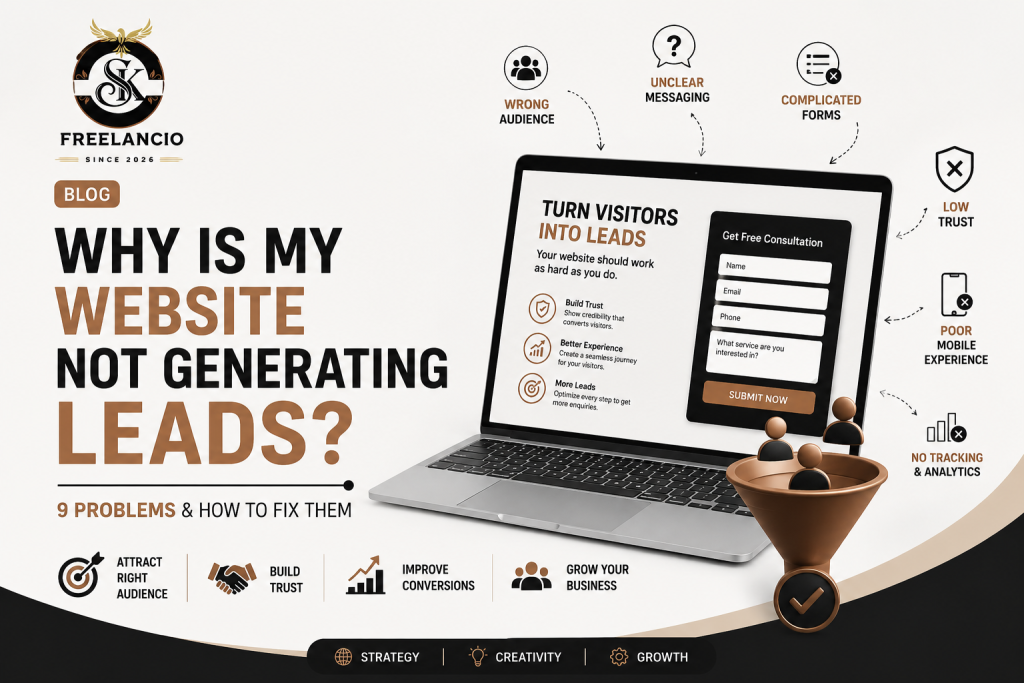
Common causes include unclear messaging, irrelevant traffic, weak CTAs, complicated forms, poor mobile experience, limited trust signals, and a weak conversion journey.
Do I need to redesign my entire website?
Not necessarily. Sometimes a few targeted improvements to your messaging, CTAs, forms, landing pages, and user experience can make a meaningful difference.
How can SEO help generate leads?
SEO can help your website appear for relevant searches and attract people who are actively looking for information, products, or services related to your business.
Can Google Ads generate website leads?
Yes, Google Ads can reach people searching for relevant products or services. However, campaign performance also depends on targeting, ad relevance, landing-page experience, offer, and conversion tracking.
How can I improve my website conversion rate?
Start by reviewing your audience, messaging, CTAs, trust signals, mobile experience, page speed, forms, landing pages, and conversion tracking.
How do I know whether my problem is traffic or conversion?
Look at your analytics. If relevant visitors are low, you likely have a visibility/traffic challenge. If visitors are arriving but rarely taking meaningful actions, your website may have a conversion problem.
Contact SKFreelancio today and let’s build a strategy that actually gets results.